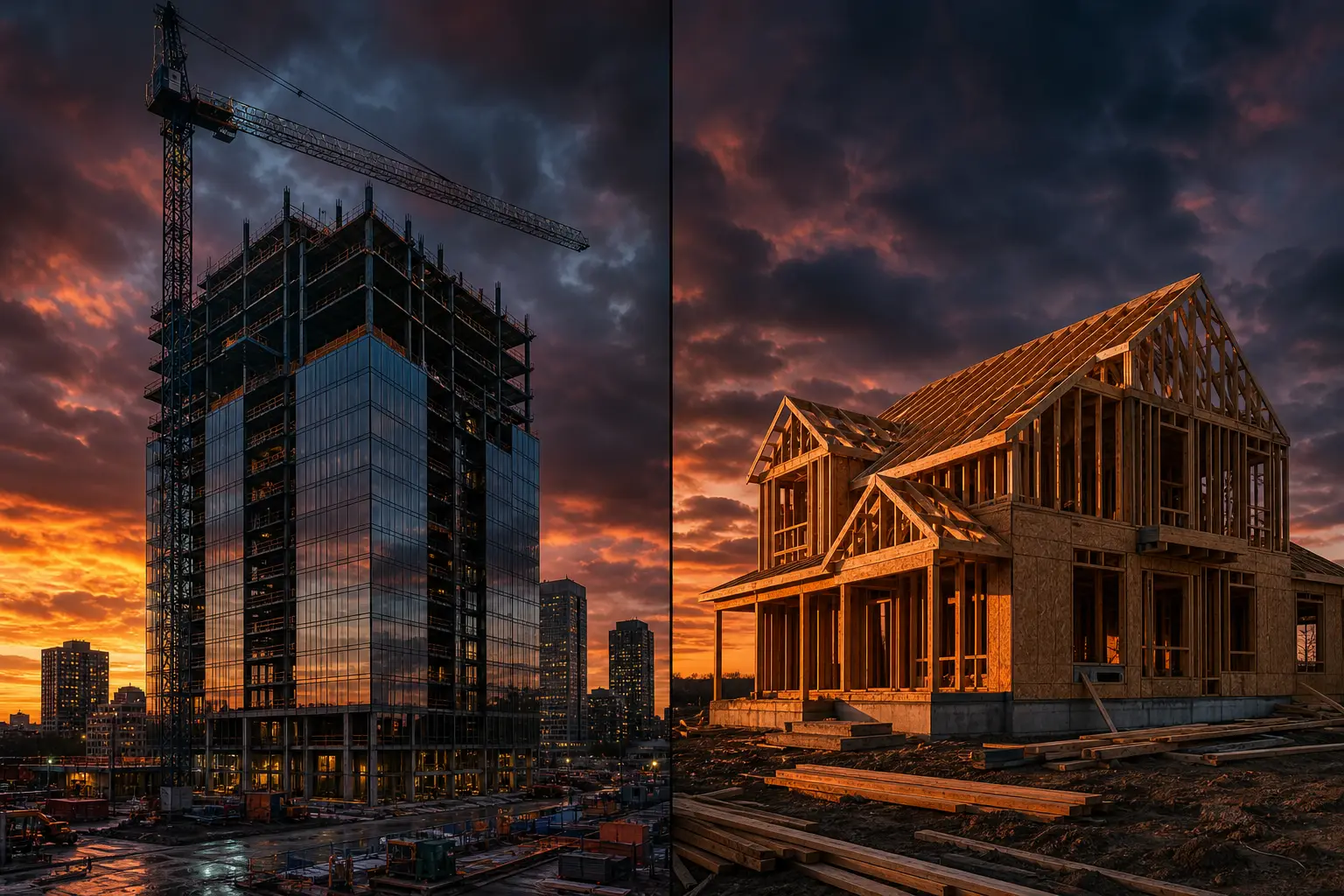
01Market Overview
Commercial and residential construction serve different customers with different needs. Understanding each market helps you compete effectively.
Residential Construction
Residential includes:
- -Single-family homes (custom and production)
- -Multi-family (apartments, condos, townhomes)
- -Remodeling and additions
- -Home repairs and improvements
Market characteristics:
- -Smaller individual projects
- -Higher volume of opportunities
- -Direct homeowner relationships
- -Seasonal patterns
- -Financing tied to consumer credit
Commercial Construction
Commercial includes:
- -Office buildings
- -Retail and restaurants
- -Healthcare facilities
- -Education and institutional
- -Industrial and manufacturing
- -Hospitality
Market characteristics:
- -Larger individual projects
- -Fewer but bigger opportunities
- -Multiple stakeholders
- -Year-round activity
- -Institutional/corporate financing
Light Commercial
A middle ground exists:
- -Small retail tenant improvements
- -Office renovations
- -Restaurant build-outs
- -Small medical/dental
This "light commercial" work bridges the markets and can be an entry point for residential contractors.
Market Size
The U.S. construction market is roughly:
- -Residential: $600+ billion annually
- -Commercial: $400+ billion annually
Both markets offer substantial opportunities for specialty contractors.
02Project Differences
Beyond just scale, commercial and residential projects differ in fundamental ways.
Plan Complexity
Residential plans:
- -Often simpler, fewer sheets
- -May lack complete details
- -More room for field decisions
- -Often drafted by designers, not architects
Commercial plans:
- -Comprehensive document sets
- -Multiple disciplines coordinated
- -Detailed specifications
- -Architect/engineer stamped
Scope Definition
Residential scope:
- -Often evolves during construction
- -Owner input throughout
- -Allowances common for finish selections
- -Changes expected and negotiated
Commercial scope:
- -Defined by contract documents
- -Change orders formal process
- -Specifications control quality
- -Changes can be contentious
Code and Inspection
Residential:
- -Standard residential codes (IRC)
- -Familiar inspection process
- -Generally fewer inspections
Commercial:
- -Commercial building codes (IBC, IFC)
- -More stringent requirements
- -Multiple inspections and testing
- -Special inspections common
Timeline
Residential:
- -Weeks to months typically
- -Weather-dependent for exteriors
- -Homeowner schedule concerns
Commercial:
- -Months to years for larger projects
- -Phased occupancy common
- -Liquidated damages for delays
Stakeholders
Residential:
- -Homeowner is customer and end-user
- -Maybe a designer or architect
- -Financing from lender
Commercial:
- -Owner (may be developer or occupant)
- -Architect and engineers
- -Construction manager or GC
- -Multiple tenant representatives
- -Inspectors and authorities
03Bidding and Contracting
The bidding and contracting process differs significantly between markets.
Getting Work
Residential:
- -Referrals are primary source
- -Direct marketing to homeowners
- -Showroom/sample presentations
- -Repeat and referral relationships
Commercial:
- -Invited or open competitive bidding
- -Plan room and bid services
- -GC relationships drive subcontract work
- -Prequalification required
Pricing Approach
Residential:
- -Often verbal estimates
- -Allowances for selections
- -Flexibility in pricing structure
- -May price in stages
Commercial:
- -Formal written proposals
- -Complete scope definition
- -Competitive pricing pressure
- -Bid bonds may be required
Contract Documents
Residential:
- -Simple proposal often sufficient
- -Standard home improvement contracts
- -May use AIA A107 for larger projects
- -Consumer protection laws apply
Commercial:
- -Formal contracts (AIA, ConsensusDocs)
- -Detailed terms and conditions
- -Subcontract pass-through provisions
- -Bonding often required
Payment Terms
Residential:
- -Deposits common
- -Progress payments by stage
- -Final on completion
- -Faster payment cycles
Commercial:
- -Monthly applications for payment
- -Retainage held (5-10%)
- -Long payment cycles (30-60 days)
- -Payment tied to schedule
Risk Allocation
Residential:
- -Simpler risk profile
- -Warranty obligations
- -Home builder liability
Commercial:
- -Complex indemnification
- -Liquidated damages
- -Performance and payment bonds
- -Professional liability exposure
04Operations and Execution
Day-to-day operations look different in each market.
Workforce
Residential:
- -Smaller, flexible crews
- -Multi-skilled workers
- -Field decisions common
- -Direct supervision by owner
Commercial:
- -Larger, specialized crews
- -Trade-specific skills
- -Following plans precisely
- -Foremen and superintendents
Tools and Equipment
Residential:
- -Personal trucks and tools
- -Hand-portable equipment
- -Basic scaffolding
Commercial:
- -Company-owned equipment
- -Specialized tools
- -Heavy equipment
- -Engineered scaffolding and platforms
Materials
Residential:
- -Retail and local suppliers
- -Standard products
- -Pickup from store common
- -Quick availability
Commercial:
- -Wholesale and specialty suppliers
- -Specified products
- -Scheduled deliveries
- -Long lead times possible
Site Conditions
Residential:
- -Occupied home concerns
- -Working around homeowner
- -Limited laydown areas
- -Neighborhood considerations
Commercial:
- -Construction sites with fencing
- -Multiple trades coordinating
- -Staging and storage areas
- -Security and safety programs
Safety Requirements
Residential:
- -Basic safety awareness
- -OSHA residential exemptions
- -Personal protective equipment
Commercial:
- -Formal safety programs
- -Site-specific safety plans
- -Regular safety meetings
- -Drug testing common
- -OSHA commercial standards
05Choosing Your Market
Most contractors specialize in one market. Understanding what suits you helps you succeed.
Skills and Preferences
Consider your strengths:
Favor Residential If:
- -Enjoy direct customer relationships
- -Prefer variety and flexibility
- -Excel at communication with homeowners
- -Want smaller, manageable projects
- -Value independence and control
Favor Commercial If:
- -Prefer structured environments
- -Excel with detailed plans and specs
- -Enjoy larger team coordination
- -Want bigger but fewer projects
- -Prefer B2B relationships
Business Model
Market choice affects business structure:
Residential typically means:
- -Lower overhead requirements
- -Smaller cash flow needs
- -Marketing to consumers
- -Reputation through referrals
Commercial typically means:
- -Higher overhead (office, staff)
- -Larger bonding and insurance
- -Marketing to GCs/owners
- -Prequalification requirements
Risk Tolerance
Risk profiles differ:
Residential risks:
- -Many small bets
- -Consumer credit exposure
- -Simpler legal disputes
- -Insurance claims
Commercial risks:
- -Few large bets
- -Complex contract disputes
- -Bond claims possible
- -Professional liability
Growth Path
Consider your growth goals:
Residential path:
- -Single crew to multiple crews
- -May add retail showroom
- -Design-build opportunities
- -Franchise/licensing options
Commercial path:
- -Small sub to large sub
- -Single trade to multi-trade
- -Regional to national reach
- -Specialty to general contractor
06Transitioning Between Markets
Moving from one market to another is possible but requires preparation.
Residential to Commercial
Common transition challenges:
- -Learning commercial bidding process
- -Building GC relationships from scratch
- -Meeting bonding requirements
- -Upgrading safety programs
- -Handling larger projects and payroll
Steps to transition:
1. Start with light commercial work
2. Build relationships with small GCs
3. Increase bonding capacity gradually
4. Hire commercial-experienced staff
5. Develop formal safety program
6. Build commercial portfolio
Commercial to Residential
Different but still challenging:
- -Learning consumer marketing
- -Developing homeowner communication skills
- -Handling project variety
- -Adjusting to smaller margins
- -Managing consumer expectations
Steps to transition:
1. Start with referrals from network
2. Develop consumer-facing brand
3. Create showroom or samples
4. Learn home improvement regulations
5. Build residential portfolio
Maintaining Both Markets
Some contractors serve both:
- -Separate estimating for each
- -Different crew assignments
- -Market-specific processes
- -Separate P&L tracking
This is harder but provides diversification.
Technology Across Markets
Tools like Tectonic work in both markets:
- -AI-powered takeoff from any plans
- -Speed advantage for quick residential bids
- -Accuracy for competitive commercial bids
- -Consistent process across project types
Technology helps bridge the gap when transitioning or serving both markets.
Key Takeaways
- 1.Commercial and residential construction differ in scale, complexity, and process
- 2.Bidding, contracting, and payment terms vary significantly between markets
- 3.Choose your market based on skills, preferences, and business model fit
- 4.Transitioning between markets requires preparation and relationship building
- 5.Technology and core estimating skills transfer across markets